Using the Enneagram (or Similar) in Writing
Personality Systems
If you haven’t heard of the Enneagram, you may have heard of Myers-Briggs, or the Big Five, or the one with four animals, or Hogwarts Houses, or…you get it, there are a lot of these…and trust me, there are more than you’d think. You may have encountered one or more of them at work, at school, or as part of some summer program or corporate retreat. All of them share one basic idea: sorting personalities into neat little boxes via tests and evaluations.
Do any of them work? In the real world, the answer seems to be in the realm of “no, but also yes.”
As far as I can tell, only one of the well-known personality tests has research or data backing it up, leaving the vast majority firmly in the realm of pseudo-science. But I get the impression that these typologies can approximate how people behave in various situations, and I’ve seen firsthand that they can improve social and professional interactions. The real-world applications here seem to be in self-awareness and communication, even if the systems aren’t as all-encompassing as advertised.
So, how does any of this help us with writing? It turns out that these systems are great at helping you build deep and consistent characters.
Think of personality typologies as a kind of character workshop: you can use them to build a character from the ground up or refine an existing character. These systems offer fully developed templates of character traits: they can tell you what your character is afraid of, what they most desire, what makes them uncomfortable, how they respond to stressful situations, how they interact with others, and so much more. Almost any of these systems provide a gold mine of information that you can apply to your characters. And because we’re writing fiction, it doesn’t matter if these systems work in real life. This is because the creators of these systems have tried very hard to describe real people, which has somewhat inadvertently provided writers with solid guidelines to create characters that have believable and consistent interactions with themselves and the world around them.
The Enneagram
For my writing, I chose the Enneagram. Part of that choice was happenstance: my wife’s company at the time was using it, and she found it intuitive and helpful, so I learned a lot about it. The Enneagram also provides more flexibility and customization than other systems, letting me fine-tune my characters’ traits. And I simply found it easiest to integrate into my process.
The Enneagram is best shown as an annular diagram, and I’ve produced my own version of it below. There are nine personality types, and you’ll quickly notice that the types aren’t isolated:
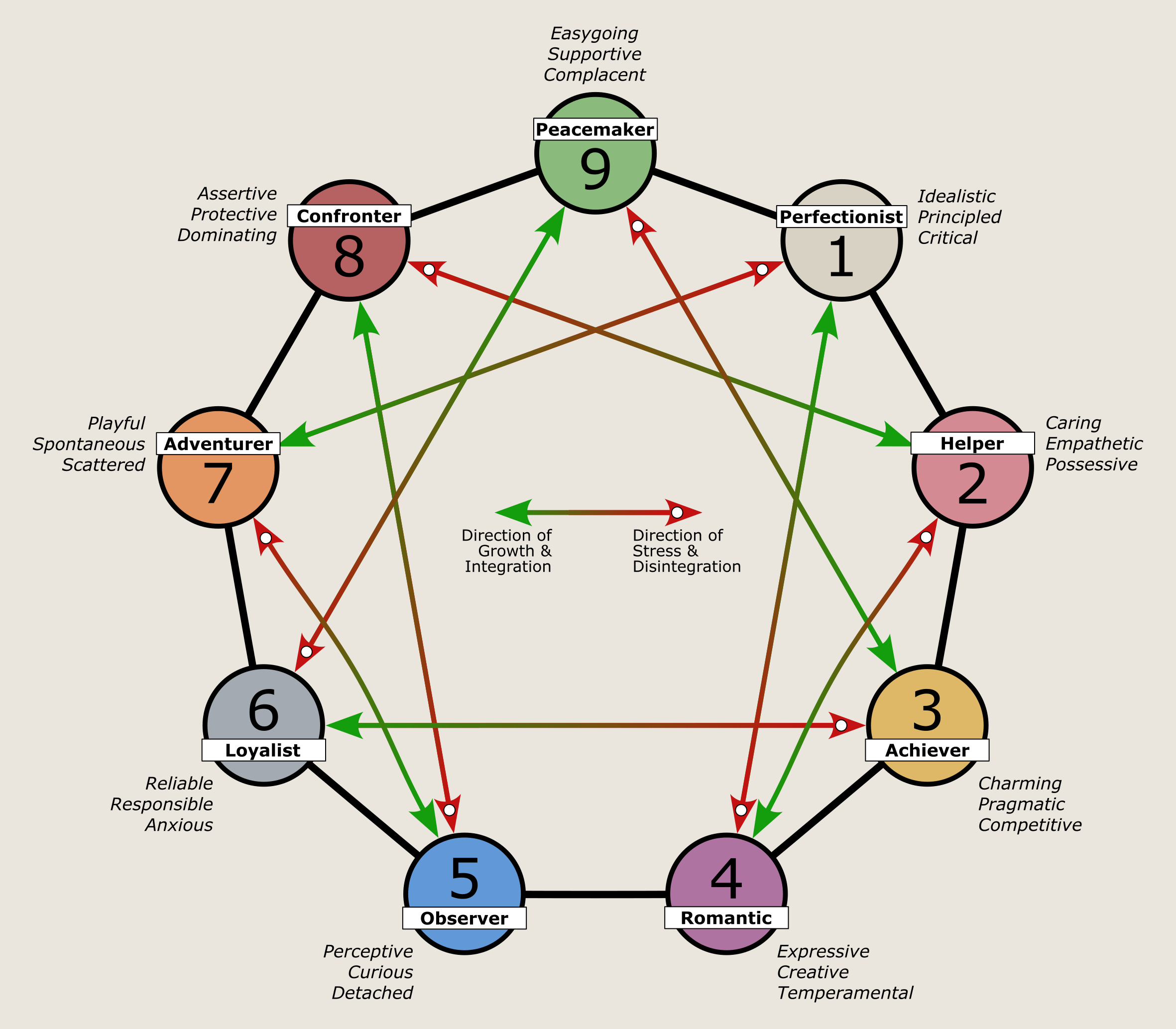
This looks different from most other personality systems, doesn’t it? You might be used to seeing the results of personality tests in lists or grids. So why is this one presented as a ring, and what are the arrows for? The shape and arrows represent the most unique aspects of this system. The arrows show a kind of personality “shift” when the person is under stress (when the person is retreating/seeking safety under pressure - the red side of the arrows with the circle) or growth (when things are going well, and the person is moving forward - the solid green arrows). And the ring shape shows you each type’s “wings.” The “wings” are the neighbors adjacent to each personality type on the ring, and each personality type can have aspects of one or both of its neighbors (or neither). This is where the Enneagram’s flexibility comes in, allowing you to adjust your character in many ways that retain a consistent feel.
Why Use the Enneagram?
The Enneagram does require a bit more manipulation and decision-making to figure out where your character sits. So why use it instead of something like Myers-Briggs, where the traits are literally right there in the letter designations? Well, truth be told, I use Myers-Briggs too, as well as Love Languages, but we’ll get to that. Here are some traits of the Enneagram that make it a good choice for character building:
Each personality type has a title that makes it easy to remember, and you can go back to that as an anchor at any time (i.e. my character just entered a room where people are stressed, frightened, and injured, what will they do? If your character’s a Type 2 (The Helper), they might jump right in and tend to the injured, while a Type 8 (The Confronter) might start shouting out orders to get people organized, while a Type 4 (The Romantic) might freeze up).
Each type comes with core motivations and fears; this can make it dead simple to determine how your character responds to situations. And it helps you, as the author, to maximize the impact of the story by prodding your character’s deepest fears and leading them towards their deepest desires.
As mentioned before, the “wings” on each type help you refine your characters by giving them additional traits.
Because of how the Enneagram shows personality types shifting based on their state of mind, it provides a template for how characters respond to stress (which will likely happen a lot in a story) and “integration” or growth (imagine a training montage, if you will, when the character is relatively safe and learning new skills).
Enneagram sources come with information about how different types interact, usually as advice for how to best communicate with others and how to guide others into understanding your own communication needs. This is great for a narrative, as it provides a template for how characters can work well together and/or conflict with each other based on their type’s traits. It can also help ground how communication and conflicts happen in friendships, romances, and antagonistic relationships.
For me, it comes down to the Enneagram’s template: I can refer to it at any point when I’m writing a scene, and craft consistent and authentic interactions and reactions. Or, as I edit, it helps me identify pieces of the work that don’t quite feel right. After a while, when you get to know your characters very well, the personality systems fall into the background, but they still offer an excellent reference whenever you need them.
Notes on Enneagram Types
The diagram shows the basics of the Enneagram’s personality types, but there’s a lot under the surface. To get a deeper perspective, here’s a list with a quick blurb on each type, links to pages with more details, and a few fictional characters that match up with each type, since I find that helpful (and you’ll find that characters can show the healthy and toxic sides of each type). The first link on each type will also show a long list of real-world people that they’ve identified as that type. For fictional characters, the typing can be a bit…squiffy: for instance, some say that Star Wars’ Princess Leia is a Type 1, while others say Type 2 (I think she’s the former), and some say that Harry Potter’s Severus Snape is a Type 4, while others said Type 6 (I think he’s most likely the latter), so take some of the typing there with a grain of salt. If this looks like something you want to use, I’d recommend looking up your favorite books, shows, etc. to see the Enneagram types of the characters; just be aware that not all of those types will fit, and that some people/sites will try hard to fill up all nine slots, even if it doesn’t make sense:
Type 1: The Perfectionist (or Reformer): an idealistic and principled type, motivated to do the right thing and improve themselves and everything around them. Some examples from popular fiction include Captain Picard (Star Trek), Hermione Granger (Harry Potter), Elsa (Frozen), Caitlyn Kiramman (Arcane), and Captain America (Marvel). Also check out this site.
Type 2: The Helper: a caring and generous type, motivated to help others while seeking love and appreciation. Some examples from popular fiction include Samwise Gamgee (Lord of the Rings), Ted Lasso (Ted Lasso), Wendy (Peter Pan), Baymax (Big Hero 6), and Annie Wilkes (Misery). Also check out this site.
Type 3: The Achiever: an energetic and productive type, motivated to achieve success and admiration. Some examples from popular fiction include Jay Gatsby (The Great Gatsby), Regina George (Mean Girls), Tiana (The Princess and the Frog), Tahani Al-Jamil (The Good Place), and Don Draper (Mad Men). Also check out this site.
Type 4: The Romantic (or Individualist): a creative and individualistic type, motivated to express themselves and be significant. Some examples from popular fiction include Anakin Skywalker (Star Wars), Belle (Beauty and the Beast), The Joker (Batman), Britta Perry (Community), and The Phantom (The Phantom of the Opera). Also check out this site.
Type 5: The Observer (or Investigator): a curious and inventive type, motivated to know and understand as much as possible and to be self-sufficient. Some examples from popular fiction include Sherlock Holmes (Sherlock Holmes), Spock (Star Trek), Dr. House (House), Hannibal Lecter (The Silence of the Lambs), and Velma Dinkley (Scooby Doo). Also check out this site.
Type 6: The Loyalist (or Questioner): a reliable and hard-working type, motivated to feel secure and supported. Some examples from popular fiction include Obi-Wan Kenobi (Star Wars), Miles Morales (Spider-Man: Into the Spider-Verse), Dwight Shrute (The Office), Bilbo Baggins (The Hobbit), and Catra (She-Ra and the Princesses of Power - most sites seem to list her as a Type 4 or 8, but I interpret her strongly as a Type 6). Also check out this site.
Type 7: The Adventurer (or Enthusiast): a playful and spontaneous type, motivated to experience new things and maintain freedom. Some examples from popular fiction include Jack Sparrow (Pirates of the Caribbean), Rapunzel (Tangled), Jake Peralta (Brooklyn Nine-Nine), Aladdin (Aladdin), and Crowley (Good Omens). Also check out this site.
Type 8: The Confronter (or Asserter/Challenger): a steadfast and assertive type, motivated to show strength and authority. This type often gets typecast (ha?) as villains, so watch out for that. Some examples from popular fiction include Benjamin Sisko (Star Trek), Tony Soprano (The Sopranos), John Sheridan (Babylon 5), William Adama (Battlestar Galactica), and, um, a lot of the characters from Game of Thrones. Also check out this site.
Type 9: The Peacemaker: an agreeable and optimistic type, motivated to create harmony and avoid conflicts. Some examples from popular fiction include Uncle Iroh (Avatar: The Last Airbender), Winnie the Pooh (Winnie the Pooh), Pam Beesly (The Office), “The Dude” (The Big Lebowski), and Miss Honey (Matilda). Also check out this site.
As a quick aside: looking through many of the fictional character Enneagram lists, there’s…not a lot of diversity, to put it lightly. So, I looked up the characters from Star Trek Discovery, quite possibly the most diverse show I’m familiar with. For those characters: Michael Burnham is a 1 (or maybe 6), Saru is a 9, Sylvia Tilly is a 6 (or maybe 7), Paul Stamets is a 5, Hugh Culber is a 9 (or maybe 2), Jett Reno is likely a 5, Keyla Detmer is a 6, Joann Owosekun is likely a 9, Adira Tal is a 9, Cleveland Booker is a 9 (or maybe 8), Phillipa Georgiou (both versions) is an 8 (providing a great look at a healthy 8 (prime universe) and an unhealthy 8 (mirror universe)), and Gabriel Lorca is an 8 (or maybe 3). Now, if you’re still feeling poorly represented, check out the following bullet point…
If you’re looking for a particular character or series/book/film, try the Personality Database. The site provides user-generated personality typologies of various real and fictional people, and includes a ton of people and characters that don’t show up on the common Enneagram lists (i.e. you’re going to find a lot more diversity here). Because the content is user-generated, take it all with a grain of salt. But if your favorite books, shows, etc. don’t show up on a lot of general lists, this can be a great source to compare characters you know well with typologies. They mostly assign Myers-Briggs and Enneagram values.
If you choose to use the Enneagram for your characters, pay attention to wings: each type can have traits of the type(s) adjacent to it (i.e. a Type 9 with a 1 Wing (stylized 9w1) might get really worked up when they see or hear something they find wrong and will risk conflict to address it (while feeling nervous and scared about it)). A type can have one wing, two wings, or no wings.
Also watch for the arrows; the links above do quite a bit to describe how each type behaves under stress or growth, and those can help detail how your characters respond to those situations.
Finally, there’s something called tri-types with the Enneagram; it’s a rabbit hole that you don’t have to go down, but it can be useful if you want to really go deep in a character’s personality details. The tri-types are based on the Enneagram’s three sections: Types 8, 9, and 1 are the “body/intuitive” ones, Types 2, 3, and 4 are the “heart” ones, and Types 5, 6, and 7 are the “head” ones. The whole body-heart-head thing is another rabbit hole, honestly, but for tri-types, the idea is that a person’s dominant type has two companion types, one from each of the other sections. For example, if you’ve got a Type 6, they’d have an 8, 9, or 1 and a 2, 3, or 4 paired with it. If that Type 6 had a 4 and a 9, for instance, it would be a 469 (The Seeker) tri-type: such a character would be focused on hard work and security, with the 9 part pushing for harmony with those around them, and the 4 encouraging the person’s hard work to emphasize their own individuality and uniqueness. And because of wings, you could potentially have a character that draws from up to five of the nine types. That sounds complicated, but it’s one of the things that makes the Enneagram so good for character-building: it gives you flexibility. You can be strict and stick to a single type with no wings or tri-types, or you can dive super deep to draw from every part of the circle that makes sense, or you can land anywhere in between. If you do want to go down the tri-type rabbit hole, here are three sources that go into a lot of detail, including summaries of every tri-type: Enneagram Universe, Depth Profile, and Katherine Fauvre.
General Enneagram Sources
There are several places where you can find Enneagram content, including different ways of looking at the system. Here are the ones that I’ve turned to most frequently:
The Enneagram Made Easy by Renee Baron & Elizabeth Wagele. This book is excellent as an overview of the Enneagram, and it provides plenty of details on each type.
Are You My Type, Am I Yours? by Renee Baron & Elizabeth Wagele. This book covers relationships between different types, reviewing what each one would typically like and dislike about the other types, and what kinds of support and conflicts can occur between each type. This can be a great resource if your story involves close friendships and/or romances.
The Enneagram Institute is an easy online source that covers just about all of the basics, and it’s what I link to in the list of types.
Psychology Junkie is another site with a bunch of information on the Enneagram, as well as Myers-Briggs, and it’s the second link in the list of types.
Personality Database is a site that lets you look up user-generated (and voted-on) Enneagram and Myers-Briggs typologies for real and fictional people, letting you search for your favorite characters or media.
What Else Can You Use?
Do you have to use the Enneagram? Of course not, and you don’t even have to use one system. If you looked at the character sheet I made, you’ll see entry fields for the Enneagram, Myers-Briggs, and Love Language. I use all three, with the Myers-Briggs and Love Language entries serving as quick-reference backups. If you do decide to use more than one system, I’d advise searching for translations between systems, just to check that you don’t end up with a highly inconsistent character (i.e. a Type 5 on the Enneagram would be unlikely to be an extraverted and feeling type in Myers-Briggs). Below, I’ll list some other personality systems that I’ve heard of or seen in action. And remember, you don’t have to believe that any of these actually work in real life: these are tools to help you create and refine your characters:
Myers-Briggs (MBTI): probably the most well-known personality typing system out there, there are sixteen entries composed of four letters each, with each letter representing a different pair: extraverted/introverted, sensing/intuitive, thinking/feeling, and judging/perceiving. I’ll often include the MBTI entries for my characters, because I find it fairly intuitive to glance at the letters and get a good picture. The linked website goes into further detail on the types.
Big Five: while not as neatly packaged or as intuitive as many other personality systems, this is one of the only ones that has some scientific backing. You might find it harder to use for writing, but it can add a level of authenticity that others can’t. This one measures five characteristics on a continuum: openness, conscientiousness, extraversion, agreeableness, and neuroticism.
Love Languages: this system is popular for romantic relationships (as you’d imagine), but it certainly works for establishing how your characters interact with friends, peers, enemies, and others, depending on how they match up with the character’s love language needs. The love languages are Acts of Service, Receiving Gifts, Quality Time, Words of Affirmation, and Physical Touch, and a character doesn’t have to have just one.
CliftonStrengths (formerly StrengthsFinder): this one is certainly more corporate, but it offers 34 “talent” categories with which you can rate your characters. You can look at online resources to get more details on those categories or you could purchase or borrow one of the books on the subject. Because this is focused on talents and careers, it may not offer the kind of interpersonal details you might want (and indeed, they seem to emphasize that this isn’t really a personality system), but if your character’s skills and/or career is hugely important to your story, something like this could help refine their strengths and weaknesses.
DISC: this system is old, but still used in many professional environments (but often as a softer version (see the next entry)). It evaluates people on four categories: Dominance, Influence, Steadiness, and Conscientiousness. The profiles will typically have one dominant quadrant, but with traits in the others (sometimes substantial, sometimes not). I don’t find this system as useful as others for writing, but you might find it (or the next one) perfect. And it can be easier than other systems to use for secondary or side characters. And many typologies that use four categories originate from DISC.
AnimalTypology: I encountered this one in an engineering camp in my high school years, and I remember getting into an argument with the person administering the test, because I wanted to select multiple options, but wasn’t allowed (I did find a test that lets you be less binary with it). It originated as a softer, more relatable version of DISC (see above). It’s still used frequently in corporate, educational, and religious contexts (the latter because it originated with a religious counselor). The classic version of it uses a Lion (decisive and dominating, like an Enneagram 8), Otter (outgoing and fun-loving, like an Enneagram 4 or 7), Golden Retriever (loyal and harmonious, like an Enneagram 6 or 9), and Beaver (detail-oriented and perfectionistic, like an Enneagram 1 or 5). The version I saw many years ago swapped the Otter for a Peacock, the Beaver for an Owl, and the Golden Retriever for something I don’t remember. So when you see a four-animal system, it’s almost always related to this.
Astrology: I feel like I need to thread a needle on this one: some people swear by astrology, and others see it as pure quackery. But for our purposes, we don’t care if it’s legitimate or not, since we’re using it to build or refine characters. You can go through the twelve Zodiac signs and either use them to generate characters or match an existing character to one of them. I’m only looking at the signs here, as you can get a lot of character building from those. But astrology has plenty of rabbit holes that you can follow, with planets and houses and birth charts and…a lot. Also check out Chinese astrology, with yearly (rather than monthly) zodiac symbols and elements, and Vedic, Mayan, and Celtic astrologies if you want more options.
Fictional Typology: are you a fan of any fictional (or real) organizations that sort people according to personality traits? Probably the most famous one is the Hogwarts Houses from Harry Potter. If that’s your jam, go ahead and sort your characters into those Houses. Do you like Avatar: The Last Airbender? Figure out if your character would be a waterbender, earthbender, firebender, or airbender (each of the bending styles does seem to pair with some consistent personality traits (or at least encourages adopting a particular set of traits)). It’s pretty clear that most of these systems share DNA with the DISC/Animal typologies, so they’re mostly different flavors of that core system. Another one that isn’t related to DISC would be the D&D alignment chart: I’m not sure how useful that is by itself, but I think it could pair very well with other systems.
This list isn’t a complete survey of every personality system out there, so if none of these feel right for your process, try a search to see if you can find one that feels good for your story/characters. You might even want to try roaming the psychology section of your local bookstore, as you might find one or more gems there to help with character-building (and the writing section may also have some good resources for this).
Many sources can provide conversions from one system to another, with conversions between Enneagram and Myers-Briggs being quite common (they’re also not exact conversions, as you’d expect). If you’re using multiple systems for character-building or revision, you can sanity check your decisions with these converters. Of course, none of this is an exact science, so treat all of this as guidelines, rather than rules.